


We are please to have Seema Yasmin today, author of Unbecoming, a novel about the fight for body autonomy, which arrives on bookshelves on July 9th. I remember seeing Seema speak at NCTE22 when she was promoting “What the Fact?” Finding the Truth in All the Noise”, and she hinted at this book. I was so intrigued about the premise as it had only been 5 months since Roe v. Wade had been overturned and the wounds were still raw. I was so happy to get an ARC of this book and to ask Seema all about what went into bringing this moving novel to life.
Also…slight warning as I’m going to try to do this interview without spoilers but just in case I let one slip….
K. Imani: I actually started reading Unbecoming on the day the Supreme Court ruled against a ban on mifepristone, which was a huge (albeit temporary) relief. At the beginning of Unbecoming, mifepristone has already been banned. What are your thoughts on the court’s ruling?
Cautious relief, but greater amounts of concern. Some of the Court’s decisions have been based on fraudulent and flawed science and I worry about how this might pan out in the future. There are also the personhood laws that are disturbing and fly in the face of science. Georgia, for example, is offering $3,000 tax deductions to people who are six weeks pregnant because they count the pregnancy as a person. (This is even if the pregnancy later ends in miscarriage.) I could go on and on but we should be aware that the overturning of Roe v. Wade was just the beginning.
K. Imani: No lie, the world that you created for Laylah and Noor was terrifying but also could be our very near future. How did you approach creating this world and how did you practice self-care while writing it?
It is our present in so many ways. At least six things I wrote in the novel have already come true, including the attack against IVF, the inability of doctors to provide emergency abortions in some states, criminalization of those helping a person get an abortion, and the fact that the overturning of Roe v. Wade led to the proliferation of state laws banning abortion. The novel mentions that Texas is soon to make abortion a criminal act punishable by the death penalty. Just a few weeks ago, we learned that the Texas GOP has just this punishment in mind.
I began to write the novel in 2019, three years before the Supreme Court would overturn Roe v. Wade. But it wasn’t difficult to imagine the world of Unbecoming. Margaret Atwood famously said the heinous acts of torture against women in The Handmaid’s Tale were inspired by real life. Every sadistic punishment, from forced births to mandated monthly pregnancy tests, had been invented by politicians somewhere. Someone on Twitter asked her: :How do you come up with this shit?” Atwood’s response: “As if I invented it.”
It was easy for me to imagine a dystopian, post-Roe America. Inspired by Atwood, I looked to countries where abortion was banned to learn how desperate people act in desperate times. And I looked closer to home, to Texas, the most dangerous state in America to be pregnant, a state in which I had worked as a science journalist covering abortion. I sought inspiration from other states with abortion laws so restrictive they might as well have enacted bans.
I remain hopeful because of community organizers and movement lawyers; and my friends, many of them poets and artists who remind me a different world is possible. That better future begins in our imaginations. That’s why I write fiction.
K. Imani: You have an impressive resume of non-fiction books published, but Unbecomingis your first fiction book. How was the writing process different for this novel versus your other books?
It wasn’t that different! I did a lot of research, took a lot of notes, wrote by the seat of my pants and then started to outline when I hit roadblocks. So, pretty much how I write non-fiction!
K. Imani: Throughout the novel Laylah and Noor are writing a guide for teens and comment many times on their research. What type of research did you have to do, if any, for this novel?
Yes, the novel contains a self-help guide! I talked to activists and asked them to imagine what they would be doing if they were teens. I looked into how younger people were organizing since they are not the apathetic monolith that people claim them to be. And I imagined what I might do if I were a student journalist, like Noor, who was stuck in a world where agency and autonomy were being ripped away from people with uteruses, and where young people felt powerless and voiceless.
K. Imani: What are you hoping teens come away with after reading your novel?
Hundreds of thousands of teens become pregnant each year in the U.S. By some estimates, the number is close to 700,000. I want pregnancy, abortion and abortion care to be part of our stories since they are part of our lives. I want Laylah and Noor’s story to disrupt perceptions of Muslim teens, of queer teens, of Texans, of religious leaders, of politicians, even! Laylah and Noor learn some lessons during the course of the week in which this novel takes place: chief among them are that you have to turn up as your whole, messy self in order for your friends to fully love you and be able to support you; and while you’re worrying about how others might perceive or misperceive you, you might be misperceiving them.
K. Imani: What was the hardest scene or chapter to write?
There’s a part where Noor has to make a decision: does she save Laylah or does she save her friendship with Laylah? I won’t say which way she goes, but it was hard—and fun—to write about this friendship dilemma. She feels stuck between a rock and a hard place, and whether we’ve supported a friend through pregnancy and abortion, or not, we can all relate to that.
K. Imani: Can you share what you are writing right now?
I’m writing a novel about a teenaged girl, climate change and mental health. And I’m working on a middle grade series called Muslim Mavericks which will be published by Simon and Schuster in the next year or so.
Thank you Seema for sharing with us all about the novel and your writing process. I really enjoyed the novel so look for more in my review of the novel in July.
Pre-order Unbecoming today so you can have it in your hands on July 9th. https://www.simonandschuster.com/books/Unbecoming/Seema-Yasmin/9781665938440
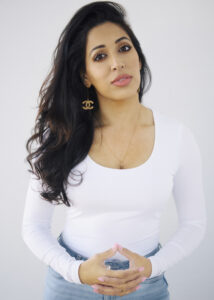 DR. SEEMA YASMIN is an Emmy Award–winning journalist who was a finalist for the Pulitzer Prize, medical doctor, professor, and poet. She attended medical school at Cambridge University and worked as a disease detective for the US federal government’s Epidemic Intelligence Service. She currently teaches storytelling at Stanford University School of Medicine, and is a regular contributor to CNN, Self, and Scientific American, among others. Her other books include What the Fact?: Finding the Truth in All the Noise, The ABCs of Queer History, If God Is A Virus, Viral BS: Medical Myths and Why We Fall for Them, Djinnology: An Illuminated Compendium of Spirits and Stories from the Muslim World, Muslim Women Are Everything: Stereotype-Shattering Stories of Courage, and The Impatient Dr. Lange: One Man’s Fight to End the Global HIV Epidemic.