

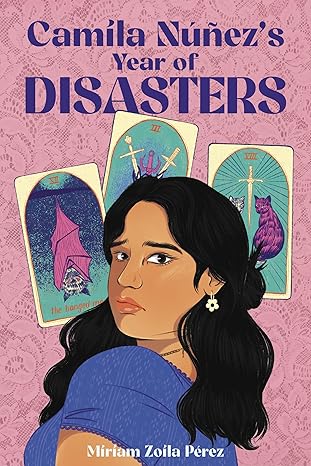
Camila Núñez’s Year of Disasters, the YA debut by Miriam Zoila Pérez, was published earlier this year. If you haven’t read it yet, here is the publisher’s summary:
Cuban American Camila Núñez has always been afraid of the future. She’s been working hard to keep her anxieties in check, but with so many new experiences―her first queer love, trouble with her dog walking job, her mother’s judgments about her body, learning to drive, her father being too busy with work―there’s just so much to worry about.
So when Camila’s best friend gives her a tarot card reading for her sixteenth birthday, she believes it when the cards predict terrible things to come. As the year unfolds, the cards seem to be spot-on―is her papi having an affair? Will her best friend’s love life ruin their friendship? Are all her relationships doomed to fail?
Whether she’s ready or not, Camila will have to reckon with all the ways her fear about the future is ruining her life and learn to find peace amidst it all.
We’re very happy to have Miriam Zoila Pérez with us today to learn more about Camila’s story.
First off, after many years of blogging, journalism, and books for adult readers, what
prompted this move into young adult writing?
So I actually started working on my first YA novel (not yet published) over ten years ago. I
had three months off between jobs and I decided I wanted to try to write fiction. I think that
audacity came from being a YA reader for so long and just really loving the genre. I wanted
to try my hand at it. I came back to it more seriously in 2019, after the first Trump presidency
really forced me to take a step back from political writing. I quite literally could not keep
following the news, it was having such a negative impact on my wellbeing. So I dove back
into that first YA draft, and once that was done, I started what became CAMILA.
Now that we’re facing another Trump presidency, I’m finding writing YA fiction to be such a
source of grounding and focus. I think it’s because I get to invent problems and then solve
them. That’s very different than the way our world feels right now.
What was it like to write about Camila’s queerness especially in relation to family and culture?
So one thing I wanted to explore with Camila was a much more accepting world than the
one I grew up in. Queerness was not accepted in my high school, even in a liberal college
town like Chapel Hill in the ‘90s and ‘00s. I often joke that Ellen Degeneres was the only
lesbian I knew growing up (and I only knew her on TV). But I’ve heard from kids who are
growing up there now that it is really normal to be queer. So it was fun to write Camila’s
experience from that place, rather than what I experienced.
But her time in Miami, where she isn’t comfortable being out to her family, reflects the fact
that many different experiences can exist at once, and the queer-friendliness we see in one
place might not show up in another place we also consider home. I think that’s the reality for
a lot of kids today, and I wanted to show that nuance, while also exploring a pretty positive
family acceptance experience.
I have only read a few books for young adults dealing with polyamory and your
characters are definitely learning as they go. Is there anything you would like to share
with young readers about navigating polyamory?
This was something I really wanted to explore, because I know that it is a part of how kids
now date. Diversity of sexual orientations and relationship styles are becoming more
accepted, and dating as a teenager is hard, so I wanted to explore both those things
together.
I don’t necessarily have any advice for young readers about polyamory, except to say that I
don’t think one relationship style is better than another, as long as everyone is open and
consenting about what they want and need. And people fail at monogamy just as often as
they fail at polyamory. We’re all just learning.
What were some of the challenges you dealt with while writing Camila’s story?
I tend to write very character-driven stories. Because of that, it can be hard to let bad things
happen to them! But I know that plot is so important to creating a compelling story. The
tarot reading actually came after I had already started writing the characters, and it helped
push me to make the plot higher stakes.
The other thing that was challenging was describing what it’s like to live with anxiety. While
Camila’s story isn’t my own, her mental health struggles do mirror mine. But when you live
with anxiety, it is so normal that you sometimes can’t even describe it. It was challenging but
also helpful for me to try and put words to this very physical and internal experience.
What do you most admire about Camila?
She’s so brave! Even though she struggles with confidence and trusting the world around
her, she’s also willing to be herself in all her imperfections. She knows herself, and she
knows what is important to her. I wish teenage me could have been a little more like her!
And I could have used a best friend like Cindy.
Do you think you will be writing more young adult books in the future?
I hope so! I have one unpublished manuscript that my agent and I are working to find a
home for, and a third that I just started working on recently. It would be a dream to get to
keep writing these stories.
Is there anything you wish I had asked you about?
One thing a lot of people – especially family and friends – want to know is whether the
characters and experiences are real. None of them are, and the things that happened are all
invented. But the one part of the book that is real is the dogs! They are all based on actual
dogs that exist in real life, and their personality traits are authentic. I hope they all feel
accurately represented in the book!
Thanks so much for taking the time to share with us about your writing!
Extras: