

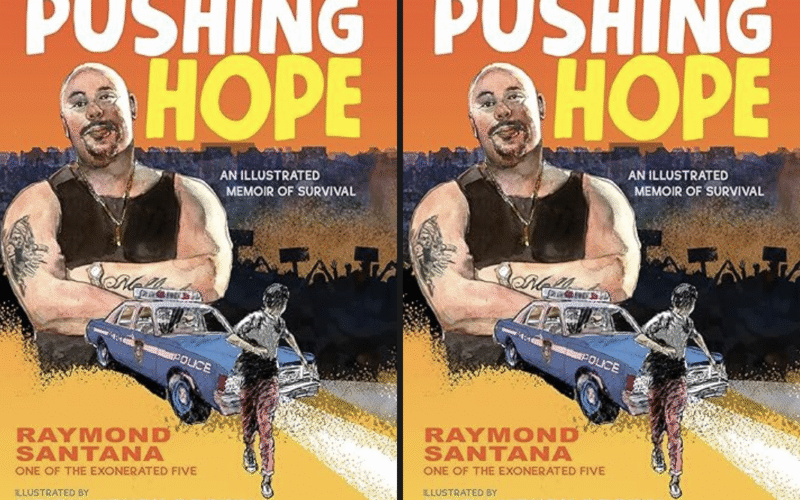
Pushing Hope: An Illustrated Memoir of Survival by Raymond Santana illustrated by Keith Henry Brown
Publisher Summary: When Raymond Santana was just 14, he was accused of a crime he didn’t commit. The 1989 rape of a jogger in Central Park was pinned on Santana and four other young teens, a tragedy that would change their lives forever.
In this powerful illustrated memoir, Raymond Santana takes readers on a journey from his move to Harlem, to his arrest and trial, and from his time in prison to his ongoing fight for justice. Exonerated in 2002, Santana has made it his mission to fight wrongful convictions and injustice. What has sustained him and given him the strength for that fight, is his creativity—art and fashion have always been a refuge and a source of hope.
Teaming up with celebrated artist Keith Henry Brown, Raymond Santana shows in vivid color how one can survive by pushing a message of hope.
My Thoughts: This format delivers a powerful story with a limited amount of words and a helpful balance of illustrations. Initially I believed this was a graphic novel, but it really is simply an illustrated memoir. There are pages with bright colors and simple text and there are many pages that are only an illustration. If there is a pattern I missed it, but it is helpful that illustrations and text are sometimes alternating, but are also sometimes paired. It keeps the reader from settling into any particular expectation. The design really helps to maintain both anticipation and tension and the illustrations support the text well.
The beginning of the book feels very young and fresh and readers can see the optimism and a little bit of anxiety as Santana shares about his move to Harlem and his love of creating art is woven throughout. Once we arrive at the night of the events in Central Park though, the text grows in size and the illustrations and background colors are very striking and really express the pressure and fear that Santana experienced. He shares his thought process as he was being interrogated and it helps to see how a young person could feel cornered and helpless in such a situation. It shows the criminal justice system from the inside.
The format makes the book easy to read in one sitting and will likely appeal to typically reluctant readers because though it tells a full and detailed story, it is all in small amounts interspersed with a lot of visual input. It’s riveting and feels like a very honest revelation of an incredibly difficult situation. And like the title implies, hope is a part of the journey. Santana shares the hard moments when giving up could have been the choice, but focuses on the hope even in the midst of so many obstacles. Getting out of prison didn’t solve all of his problems and as he says, there was no blueprint for how to live life after he was released .
Recommendation: Get it soon. This is a fascinating look at the justice system and how one person navigated his way through and beyond. The format is especially appealing. The book would be excellent on its own, but it would also be even more amazing when paired with Punching the Air by Ibi Zoboi and Yusef Salaam which is a novel in verse by another member of The Exonerated Five. [Interview with the authors here]
Extra:
Brief message from author
Conversation with the author
Publisher: Calkins Creek
Pages: 288
Review copy: Final copy via publisher
Availability: October 28, 2025 Release Date