


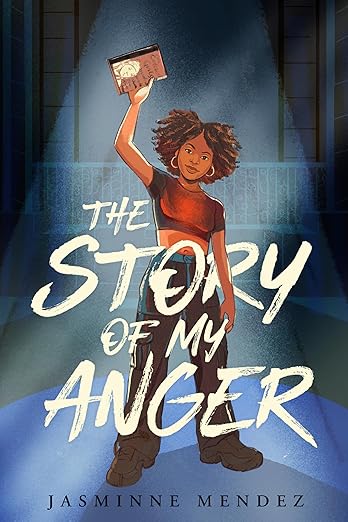
 Title: The Story of My Anger
Author: Jasminne Mendez
Genres: Contemporary, Poetry
Pages: 336
Publisher: Dial Books
Review Copy: Purchased
Availability: Available now
Summary: Yulieta Lopez is angry. Angry at her racist drama teacher who refuses to cast Black students in lead roles. Angry at the school board threatening her favorite teacher for teaching works of literature that they deem “controversial.” Angry that she has to keep quiet until she can head to college and leave Texas forever.
Yuli is accustomed to playing various roles: the diligent daughter, the honorable hija, the good girl who serves everyone else before serving herself. But as the fire of Yuli’s rage spreads and lights her up, she can no longer be silent. Determined to find a way to fight back, Yuli and her friends start a guerrilla theatre club which stirs things up and gets people talking, and finally, Yuli steps into the role she was always meant to play.
Review: [Racism is a significant focus in this book, including usages of racial slurs. There are also subplots/mentions of homophobia, transphobia, parental death, and police violence against college protestors.]
While author Jasminne Mendez says in her author’s note that THE STORY OF MY ANGER was based on 2012 book bans in Arizona, this novel fits right into 2025 book bans across the United States. THE STORY OF MY ANGER is both a direct refutation of censorship in schools while also affirming exactly why BIPOC, LGBTQIA+, and other minority students deserve to have access to educations that acknowledge their humanity. The book is a clever mix of free verse poems and scenes that are blocked out like scripts for a play, which gives us both a first-person point of view directly from Yuli (and sometimes others, via monologues!) and more distant third-person for carefully selected scenes.
Yuli’s narration is powerful and direct, even when she spends a good portion of the book reigning in her frustration at her and other minority students’ treatment at school. I really appreciated how she weighed when to speak up and how to resist, balancing her anger at injustice and desire to do what’s right against her mom’s health, the potential loss of opportunities at school, personal missteps, and fallout for others. I liked the nuanced take on those decisions and how Yuli’s parents’ and brother’s activism aligned and differed from hers, including in the outcomes.
This is a book that will make a reader angry on Yuli’s behalf—in a way, I hope, that will eventually move readers to action. There is obvious and ugly pushback to Yuli’s guerrilla theater work to try to reverse her school’s book bans, with two characters as the figureheads for (different flavors of) bigotry. This isn’t a story where a just a handful of acts of resistance solve all problems, and THE STORY OF MY ANGER instead treats Yuli’s first steps in an activist movement as starting points for further work. Yuli is angry—and she’s hopeful, too, that her and others’ efforts will bring about change. There are wins and there are losses, but you won’t doubt that Yuli will keep fighting.
Recommendation: Get it soon if you like novels in verse. THE STORY OF MY ANGER tackles book bans head on, and it is a timely entry to the YA canon in 2025. Author Jasminne Mendez has crafted a fast-paced, nuanced take on youth activism, and its ultimately hopeful narrative about a teenager doing what she can to fight against injustice in her school system is a worthwhile read.